Why Morgan Stanley’s MSBT Changes Everything


The real story isn't just "another ETF." MSBT It is the integration of Bitcoin into the core advisory workflow of a global financial powerhouse.
Morgan Stanley’s Bitcoin ETF (MSBT)
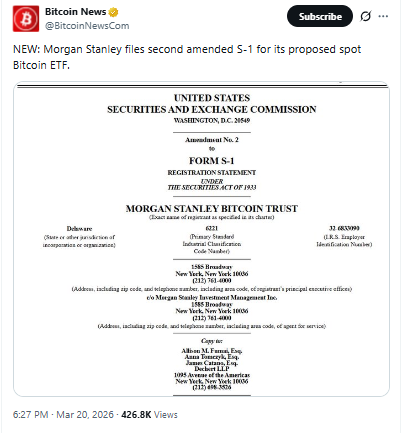
In March 2026, Morgan Stanley submitted an amended S-1 filing to the U.S. Securities and Exchange Commission for its proposed spot Bitcoin ETF, the Morgan Stanley Bitcoin Trust (MSBT). At face value, the filing appears to be a continuation of the wave that began in early 2024, when asset managers such as BlackRock and Fidelity Investments brought spot Bitcoin ETFs into the mainstream. However, the MSBT filing represents something materially different.
This is not simply another entrant in an already crowded ETF landscape. It is the first instance of a major global investment bank moving beyond distribution into direct issuance of a Bitcoin ETF. That distinction, while subtle in form, has significant implications for how capital enters the Bitcoin market, how financial products are recommended, and how Bitcoin is positioned within traditional portfolios. To understand the significance of MSBT, it is necessary to move beyond surface-level comparisons and examine the structural differences between bank-issued ETFs and those created by asset managers.
Understanding the MSBT Structure
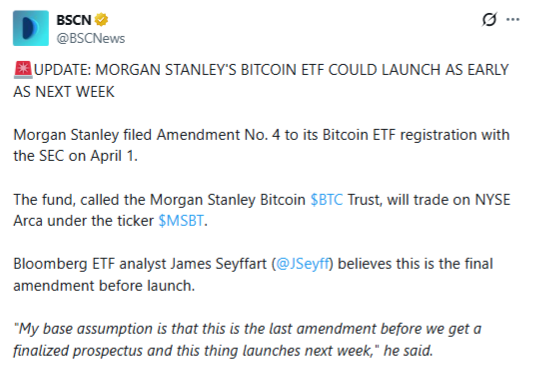
The Morgan Stanley Bitcoin Trust is designed as a spot Bitcoin ETF that directly holds Bitcoin rather than relying on futures contracts or synthetic exposure. From a structural perspective, it aligns with the existing generation of spot ETFs, but with some nuances worth highlighting. The fund operates as a passive investment vehicle, with shares representing fractional ownership of the underlying Bitcoin reserves. Pricing is derived from the CoinDesk Bitcoin Benchmark Index, using a standardized New York close. Like other institutional-grade ETFs, it supports both cash and in-kind creation and redemption mechanisms, allowing authorized participants to interact with the fund efficiently.
Operationally, the trust relies on established institutional infrastructure. Coinbase Custody is responsible for safeguarding the Bitcoin in cold storage, while BNY Mellon handles cash custody, fund administration, and transfer agency functions. These choices reflect continuity with existing ETF structures rather than experimentation. What remains undisclosed, at least publicly, is the fee structure. Early indications suggest a potential fee waiver period designed to accelerate early adoption, a strategy that has already proven effective in the initial ETF wave of 2024. At a technical level, MSBT does not introduce innovation. Seed capital: $1 million initial investment. 50,000 shares at $20.00 per share. Morgan Stanley purchased 2 shares on March 9, 2026, for auditing purposes. Creation unit: 10,000 shares minimum per creation basket, a standard structure for large institutional ETFs.
The Evolution of Bank Involvement in Crypto ETFs (2024–2026)
Banks have been cautious about crypto products. In 2024, most major banks limited themselves to offering third-party Bitcoin ETFs to select clients. By late 2025, Morgan Stanley expanded access to all advisory clients. The March 2026 amended S-1 filing marks the first time a major US bank has moved from distribution to direct issuance of a spot Bitcoin ETF. This shift reflects growing institutional comfort with Bitcoin as an asset class and the competitive pressure to offer proprietary products.
Why Is a Bank-Issued Bitcoin ETF Different From BlackRock's IBIT?
The distinction between a bank-issued ETF and an asset-manager-issued ETF is not cosmetic. It changes the distribution model, the client base, and the potential scale of capital flows.
The Distribution Advantage
BlackRock, Fidelity, VanEck, and other existing Bitcoin ETF issuers are asset management companies. They create investment products and distribute them through third-party broker-dealer networks, financial advisor platforms, and direct-to-consumer channels. They do not own the client relationship. Morgan Stanley owns the client relationship. Its 15,000+ financial advisors sit in private offices with high-net-worth individuals and institutional allocators who have $8 trillion in combined assets.
When Morgan Stanley issues MSBT, those advisors can recommend it directly during portfolio reviews, retirement planning sessions, and wealth transfer conversations. There is no middleman, no third-party distribution hurdle, and no compliance team at another firm deciding whether to approve the product for their platform. Since October 2025, Morgan Stanley has authorized its financial advisors to recommend Bitcoin ETFs to all clients, including those with retirement accounts (IRAs, 401(k)s). Previously, access was limited to high-net-worth clients with aggressive risk tolerance. MSBT takes this further by giving advisors a proprietary product to recommend rather than a third-party one.
The Scale Difference
Strategy CEO Phong Le put the potential into context on X (formerly Twitter) after the March 20 filing: "Morgan Stanley Wealth Management oversees about $8 trillion in AUM and recommends 0-4% bitcoin allocation. A 2% allocation would represent $160 billion, ~3X the size of IBIT. $MSBT: Monster Bitcoin. "For context: BlackRock's IBIT has accumulated over $54 billion in AUM as of March 2026, with cumulative net inflows exceeding $63 billion since its January 2024 launch, making it the fastest-growing ETP in history. The entire US spot Bitcoin ETF market holds approximately $128 billion in combined AUM.
If even half of Le's estimate materializes ($80 billion), MSBT would be the largest Bitcoin ETF in the world. The critical caveat: Le's $160 billion figure assumes a full 2% allocation across all $8 trillion, which is an upper-bound estimate. Joe Takayama of Backpack cautioned that actual allocation could be "below 2% or even close to zero." As of early 2026, about 80% of crypto ETF adoption on Morgan Stanley's platform comes from self-directed investors, not advisor-managed accounts. The advisory channel is where the real growth potential sits, but it has not yet been meaningfully activated.
 Source : BSCNews
What This Signals to Other Banks
If Morgan Stanley receives SEC approval for MSBT, it establishes a precedent for other major banks to follow. Goldman Sachs, JPMorgan, and Bank of America all have wealth management divisions with trillions in client assets. None have yet filed for their own spot Bitcoin ETFs, but analysts expect that Morgan Stanley's move will accelerate internal evaluations at these firms. The competitive pressure is straightforward: if Morgan Stanley advisors can offer clients a proprietary Bitcoin ETF and competitors cannot, those competitors risk losing advisory relationships.
Current Bitcoin Price Context and MSBT Filing Impact (April 2026 Update)
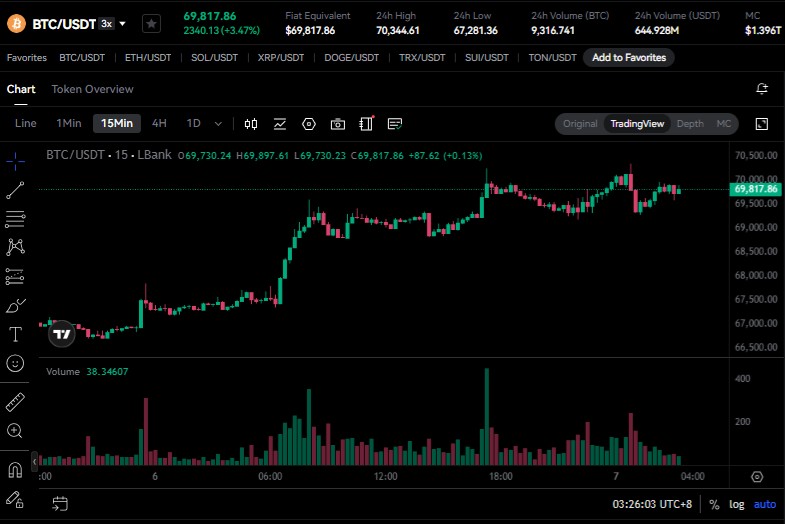
As of April 2026, Bitcoin is trading in the $68,000–$72,000 range, roughly 46% below its all-time high of $126,210 set in October 2025. The MSBT filing came during a period of market pessimism, yet it was interpreted as a strong bullish signal by many analysts. Banks rarely file for major products when they expect failure the timing suggests Morgan Stanley sees the current price level as an attractive entry point for its clients. The filing itself did not cause an immediate price surge, but it contributed to a sentiment shift. Bitcoin gained roughly 4–6% in the days following the amended S-1, as traders began pricing in the potential for significant new institutional inflows. The real price impact will come after approval and launch, when actual capital flows into Bitcoin through ETF creation baskets.
What Does This Mean for Bitcoin's Price?
The MSBT filing alone does not move Bitcoin's price. What moves price is actual capital flowing into Bitcoin through ETF creation baskets after approval and launch. However, the filing sends important signals: Institutional validation at the bank level. Potential demand scale. Even conservative estimates suggest meaningful flows. Precedent for other banks. The timeline caveat: SEC approval is not guaranteed or on a fixed timeline. The SEC is currently reviewing over 126 pending crypto ETF applications. If you are positioning around this catalyst, treat it as a medium-term thesis (months to quarters), not a day trade.
How MSBT Could Reshape the Entire Bitcoin ETF Market
If approved, MSBT would set a precedent that could trigger a wave of bank-issued Bitcoin ETFs. Goldman Sachs, JPMorgan, and Bank of America all have massive wealth management divisions with trillions in client assets. A successful MSBT launch would create competitive pressure for these banks to launch their own products to avoid losing advisory relationships. The cumulative wealth management AUM across major US banks exceeds $30 trillion. Even a modest 0.5–1% allocation across these platforms could bring tens of billions in new demand potentially dwarfing the $128 billion currently held in all existing spot Bitcoin ETFs. This would mark a structural shift: Bitcoin moving from a self-directed retail asset to a core allocation recommended by traditional wealth advisors.
What Are the Risks and Limitations of the MSBT Thesis?
No analysis of MSBT is complete without acknowledging what could go wrong:
- SEC delay or rejection.
- Advisor adoption may be slow.
- Fee competition.
- Bitcoin price risk.
- Distribution channel conflict.
Risks Specific to Bank-Issued ETFs
Bank-issued ETFs carry unique risks beyond those of traditional asset-manager ETFs. Distribution conflict is a major one: Morgan Stanley’s financial advisors currently earn commissions by recommending third-party products like IBIT and FBTC. Switching to a proprietary product may face internal resistance unless compensation structures are adjusted. Regulatory scrutiny is also higher for banks. The SEC and other regulators may apply stricter standards to bank-issued products due to the potential systemic importance of the issuer. Finally, advisor adoption may be slower than expected many conservative clients and advisors are still hesitant to recommend Bitcoin exposure, especially while prices remain well below all-time highs.
How Can I Position Around the MSBT Catalyst?
For Long-Term Investors
The simplest approach accumulate Bitcoin at current prices ($68,000–$72,000 range as of March 2026) before MSBT approval and launch potentially drive the next wave of institutional demand. LBank offers BTC/USDT spot trading at 0.1% fees (0.08% with BGB discount), and free DCA bots to automate accumulation over time.
For Active Traders
Monitor SEC filing updates for MSBT approval signals. Key dates to watch: any new amendments to the S-1, 19b-4 rule change filings on NYSE Arca, and SEC comment/response cycles. LBank BTC/USDT futures with up to 125x leverage allow leveraged positioning around approval catalysts. Use stop-losses to manage risk around binary regulatory events.
For Copy Traders
Lbnk copy trading lets you follow elite traders who specialize in event-driven Bitcoin strategies. View their track records across previous ETF approval events and automatically replicate their positions.
Future Outlook
What Happens After MSBT Launches? (2027–2028)If MSBT launches successfully in 2026, it could fundamentally change the Bitcoin ETF landscape. Analysts expect other major banks to follow suit, potentially bringing $50–$100 billion in new institutional capital into Bitcoin over the next 18–24 months. By 2027–2028, we could see a multi-bank Bitcoin ETF ecosystem where Morgan Stanley, Goldman Sachs, and others compete directly with BlackRock and Fidelity. This would accelerate mainstream adoption and likely push Bitcoin toward new all-time highs as trillions in traditional wealth management assets begin to allocate even small percentages to BTC. For traders on Lbnak, this period will present ongoing opportunities: higher liquidity, more institutional flows, and increased volatility that can be traded using futures and copy trading tools.
Conclusion
The significance of MSBT lies not in its novelty as a financial product, but in what it represents for the evolution of Bitcoin within traditional finance. For the first time, a major investment bank is not merely facilitating access to Bitcoin, but actively integrating it into its product suite and advisory framework. This marks a transition from passive acceptance to active participation. If successful, MSBT could accelerate the normalization of Bitcoin as a portfolio allocation, moving it further into the realm of institutional finance. The process is unlikely to be immediate or linear, but the direction of travel is increasingly clear. Bitcoin is no longer operating at the periphery of the financial system. Through vehicles like MSBT, it is being incorporated into its core structures.
Disclaimer
This article is for informational purposes only and does not constitute financial or investment advice. Cryptocurrency markets involve significant risk, and readers should conduct their own research before making financial decisions.