The New Frontier of DeFi Exploits in 2026
 Abdul Razzaq2026-05-05
If you think your DeFi assets are safe because the smart contract was audited, think again. The $293M KelpDAO hack didn't break the code it broke the bridge.Here is how the most sophisticated hackers
The $293 Million DeFi Exploit That Exposed a Hidden Weakness
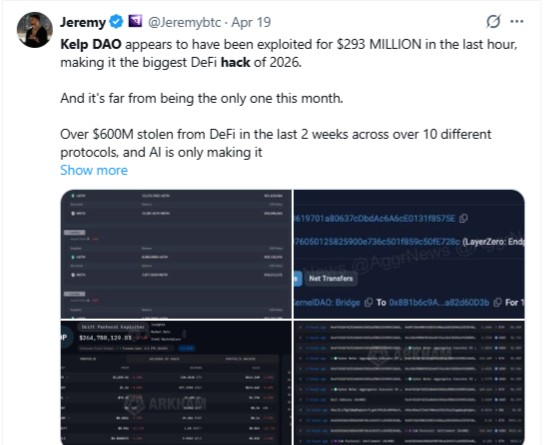
On April 18, 2026, the decentralized finance ecosystem faced one of its most significant security breaches of the year. In a highly coordinated attack, approximately $290–293 million worth of assets around 116,500 rsETH were drained from KelpDAO’s bridge infrastructure.
At first glance, it may appear similar to previous DeFi exploits. But this incident stands apart for a critical reason: it was not caused by a flaw in smart contract logic. Instead, it exposed a deeper and more concerning vulnerability the fragility of off-chain infrastructure that many protocols quietly depend on. This distinction matters. Because while smart contracts have become more secure over time, the systems surrounding them are now becoming the primary attack surface.
What Is KelpDAO?
KelpDAO is a liquid restaking protocol built primarily on Ethereum, designed to enhance capital efficiency for users participating in staking ecosystems. Through integrations with restaking frameworks like EigenLayer, KelpDAO allows users to restake ETH and receive a liquid derivative token rsETH. This token can then be deployed across DeFi for lending, collateralization, or trading, effectively allowing users to earn yield while maintaining liquidity.
By early 2026, rsETH had grown into a significant asset within the restaking landscape, deeply integrated across multiple DeFi protocols. A key part of this expansion relied on cross-chain functionality, facilitated by infrastructure such as LayerZero. That reliance, however, became the protocol’s weakest link.

Timeline of the Attack
The exploit unfolded rapidly, highlighting how quickly modern attacks can escalate. At 17:35 UTC, attackers initiated the sequence by submitting a forged cross-chain message. The message falsely indicated that a large amount of rsETH had been burned on Unichain, an L2 environment associated with Uniswap. Because the system was configured with a single-verifier setup, the message was accepted without sufficient redundancy checks. This triggered the release of approximately 116,500 rsETH from Ethereum-based escrow contracts to attacker-controlled wallets.
Within minutes, the funds were gone. Roughly 46 minutes later, KelpDAO’s emergency multisig intervened, pausing the protocol. Two subsequent attempts to drain an additional 80,000 rsETH worth around $200 million were successfully blocked due to this response. Despite the partial containment, the primary damage had already been done.
How the Attack Worked
What makes this exploit particularly important is the method. Rather than exploiting a bug in smart contract code, the attackers targeted the infrastructure layer that validates cross-chain communication. The attack involved multiple coordinated steps:
- First, RPC nodes used by LayerZero’s verifier network were either compromised or manipulated. This gave attackers control over how verification data was interpreted.
- Second, a distributed denial-of-service (DDoS) attack was launched against legitimate nodes. This forced the system to rely on fallback nodes some of which were under attacker influence. With this control in place, the attackers generated a forged message that appeared valid within the system’s trust model.
- Finally, due to KelpDAO’s 1-of-1 verifier configuration, a single approval was enough to authorize the release of funds.
This configuration choice likely made to reduce latency and costs eliminated redundancy. And in security systems, lack of redundancy is often equivalent to a single point of failure.
Attribution: The Role of Lazarus Group
Security firms, including LayerZero and Chainalysis, have attributed the attack with high confidence to the Lazarus Group, a state-sponsored hacking organization linked to North Korea. More specifically, the subgroup known as “TraderTraitor” is believed to be responsible.
This is not an isolated incident. In the same month, Lazarus was also connected to:
- The Drift Protocol exploit, which resulted in losses of approximately $285 million
- A smaller but related attack on Hyperbridge
What stands out is the pattern. These are not opportunistic hacks exploiting simple vulnerabilities. They are long-term, targeted operations, often involving months of preparation and multiple attack vectors. The focus has clearly shifted toward high-value infrastructure bridges, restaking systems, and cross-chain protocols.
Immediate Impact on the DeFi Ecosystem
The consequences of the attack were immediate and widespread. The rsETH token rapidly lost its peg, triggering instability across lending platforms. Protocols such as Aave and others quickly moved to freeze or restrict rsETH as collateral to prevent further systemic risk. This reaction, while necessary, contributed to a broader liquidity shock.
Within days, more than $13 billion in total value was withdrawn from DeFi platforms one of the fastest capital outflows observed in recent years. The incident highlighted a key reality: modern DeFi is highly interconnected. A failure in one component especially a bridge can cascade across multiple systems, affecting liquidity, collateral stability, and user confidence simultaneously.
Lessons for Protocols and Users
The KelpDAO exploit reinforces several critical lessons for the industry.
- First, redundancy is no longer optional. Systems that rely on single verifiers or simplified trust models are inherently vulnerable. Multi-verifier configurations and decentralized validation mechanisms should be considered baseline requirements.
- Second, security must extend beyond smart contracts. Off-chain infrastructure RPC nodes, oracles, and verification layers must be treated with the same level of scrutiny as on-chain code.
- Third, response mechanisms matter. While KelpDAO suffered significant losses, its rapid pause mechanism prevented additional damage. This demonstrates the value of having well-defined emergency controls.
- For users, the lesson is equally clear. Overexposure to a single asset or protocol especially one dependent on complex infrastructure can amplify risk. Diversification and awareness of underlying mechanisms are essential.
A Turning Point for DeFi Security
This attack, combined with other high-profile exploits in 2026, signals a shift in how DeFi must approach security. The industry has made significant progress in smart contract auditing and formal verification. But attackers have adapted. They are now targeting the layers that sit outside the blockchain itself the interfaces, communication channels, and trust assumptions that enable scalability. This evolution requires a corresponding shift in mindset. Security can no longer be treated as a checklist item completed before deployment. It must be integrated into every layer of the system, continuously tested, and designed with adversarial conditions in mind. Protocols that recognize this shift and invest accordingly will be better positioned to maintain user trust in an increasingly hostile environment.
Conclusion
The $293 million KelpDAO exploit is not just another entry in the list of DeFi hacks. It is a case study in how modern attacks are evolving and where the next vulnerabilities are likely to emerge. The core issue was not a broken contract, but a fragile connection. As DeFi continues to scale and interconnect, these connections become both its greatest strength and its greatest risk. The lesson is clear: speed and efficiency cannot come at the cost of resilience. Because in today’s environment, the most dangerous vulnerabilities are not always visible in the code they exist in the assumptions behind it.
Disclaimer
This article is for informational and educational purposes only. It does not constitute financial, investment, or trading advice. Cryptocurrency and DeFi involve significant risk of loss. Always conduct your own research and exercise caution.