Political Betting Scandal Hits Prediction Markets
 lu****@gmail.com2026-04-23
Kalshi’s ban on three candidates betting on their own races signals a crackdown on insider trading. To gain institutional legitimacy, markets must prioritize integrity over speculation.
The explosive growth of prediction markets as a instrument of measuring public opinion and forecasting political events now confronts a significant ethical and regulatory problem. Since the recent crackdown of Kalshi, there is a rising fear of insider trading if candidates with leverage and resources decide to further their own campaign through the prediction market.
Unsurprisingly, two US congressional aspirants, as well as one sitting MP, have been singled out and banned after making bets on their own elections. It raises fundamental questions about fairness and openness, along with what is and isn‘t acceptable in a promising new investment paradigm.
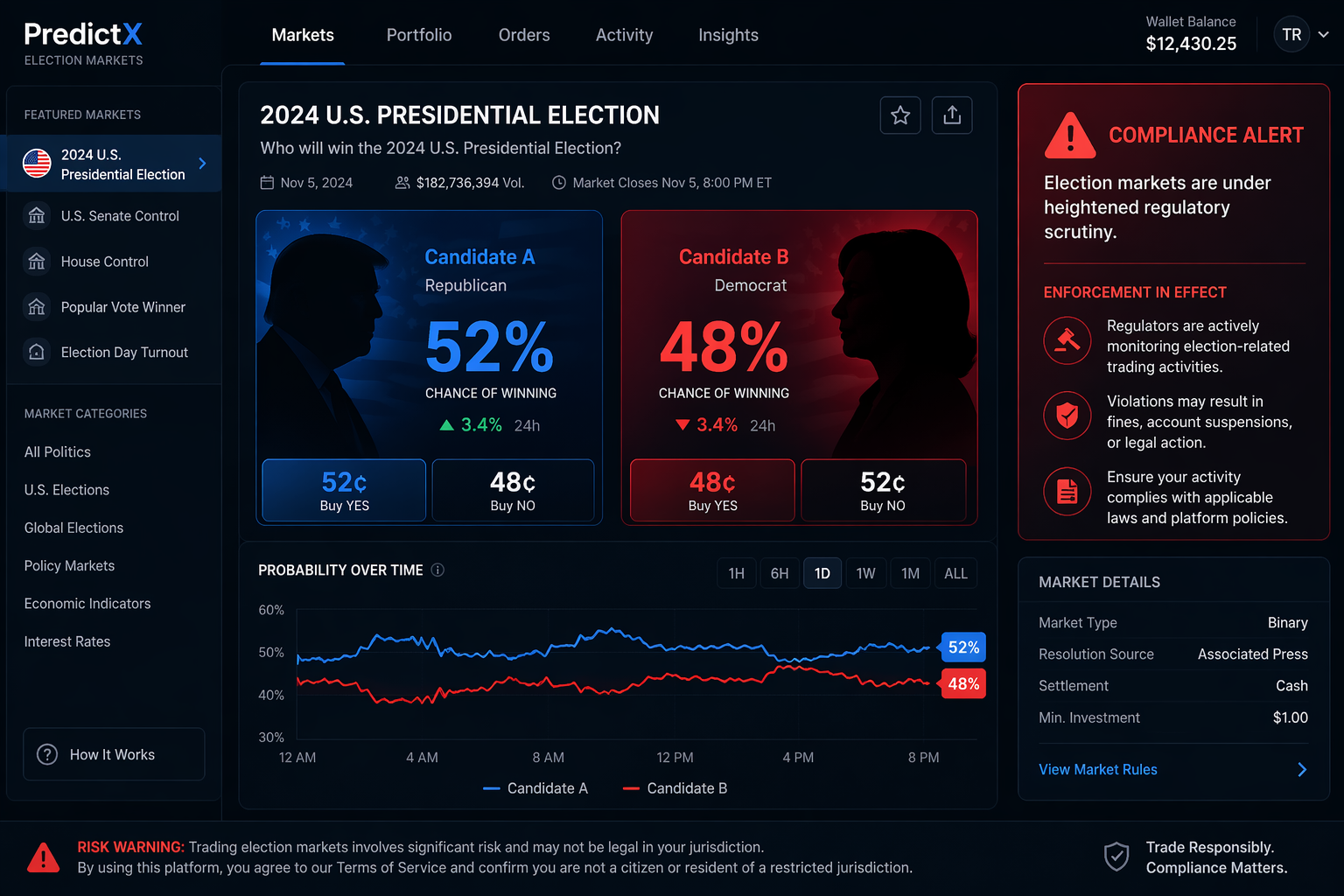
Where markets meet politics—probabilities shift, but compliance is constant.
What Happened
Three individuals were at the center of Kalshi’s enforcement action:
Mary Klein, a State Senator from Minnesota and primary candidate for the US House of Represenatives, was fined $539 for betting on his primary race in August.
Ezekiel Enriquez, a congressional candidate in the election this year, was fined $784.
Mark Moran was subject to the harshest penalties a sum of $6,229, an order to forfeit profit, and punishment after supposedly refusing to help the platform with its investigation.
All three were also temporarily restricted from trading on Kalshi for five years.
Why This Matters
Prediction markets such as Kalshi and Polymarket enable users to buy and sell events that will come to pass such as the outcome of elections. These markets were popular because they distill the belief of the crowd into measureable probabilities.
But a major conflict of interest arises when the stakeholders can directly impact the result of an event, such as candidates wagering on their own elections.
This is not just a technical violation of platform rules. It raises deeper concerns:
Insider Advantage
Candidates have private knowledge of campaign strategy, internal polling, campaign funding and voter outreach. Wagering with this knowledge puts other players at a disadvantage.
Market Integrity
Prediction markets are built upon trust. If participants ever come to believe that some outcomes are the result of manipulation by a few, the entire system will break down.
Regulatory Pressure
Already, regulators are examining the potential for prediction markets to make it difficult to distinguish between a financial security and gambling. Such incidents drive the risk of an even more cautious stance.
How Kalshi Responded
Kalshi‘s response is indicative of a trend toward heightened police and enforcement. The platform issued fines, banned individuals, and required a disgorgement of profits in the most severe case.
It is part of a much broader effort to position as a legitimized and regulated financial market rather than get involved in speculative betting.
Key actions taken include:
Penalties for violations fining relative to severity
Multi-year bans for serial offenders
Publishing information concerning enforcement actions to show transparency
The Bigger Picture for Prediction Markets
This occurred at a time when prediction markets are a hot topic.
They are being used to predict:
Results of elections
Economic indicator
Policy Decisions
Significant international events
However, all of this has brought about some degree of culpability.
Tightening Rules
Kalshi and Polymarket have also vow to implement tougher restrictions, such as stronger identification and surveillance of insider actions.
Legal Uncertainty
In the US, prediction markets are navigating through a delicate regulatory balancing act. Entities such as the CFTC are paying particular attention to the way prediction markets develop.
Reputation Risk
For prediction markets to achieve institutional acceptance strong governance is essential. Incidents involving political insiders put that progress at risk.
Ethical Questions Moving Forward
The problem is not about legality so much.
Allowed candidates into any part of the market at all?
The optics and room for abuse make it seem very hard to justify, even if through any technicalities it is allowed.
The problem is analogous to the traditional financial markets where insiders are not allowed to trade on non public information. We need to replicate the same regulation on prediction market to make prediction markets viable in the long run.
Conclusion
The fines levied on Kalshi are a turning point for prediction markets. The prediction market, which was once an innovative tool for prediction, is now faced with real world ethical issues.
With players like Kalshi and Polymarket campaigning for legitimacy, we can be sure that actions like these will be on the rise. Prediction markets cannot afford to take the risk of having no rules, not in a game where democracy is at stake.
References
If prediction markets are to be regarded as real financial instruments, they will have to behave as such. And that means having a clear cut-off point when owners try to bend the rules.