The SEC’s Crypto Reset Under Paul Atkins
 Natalia Ivanov2026-04-23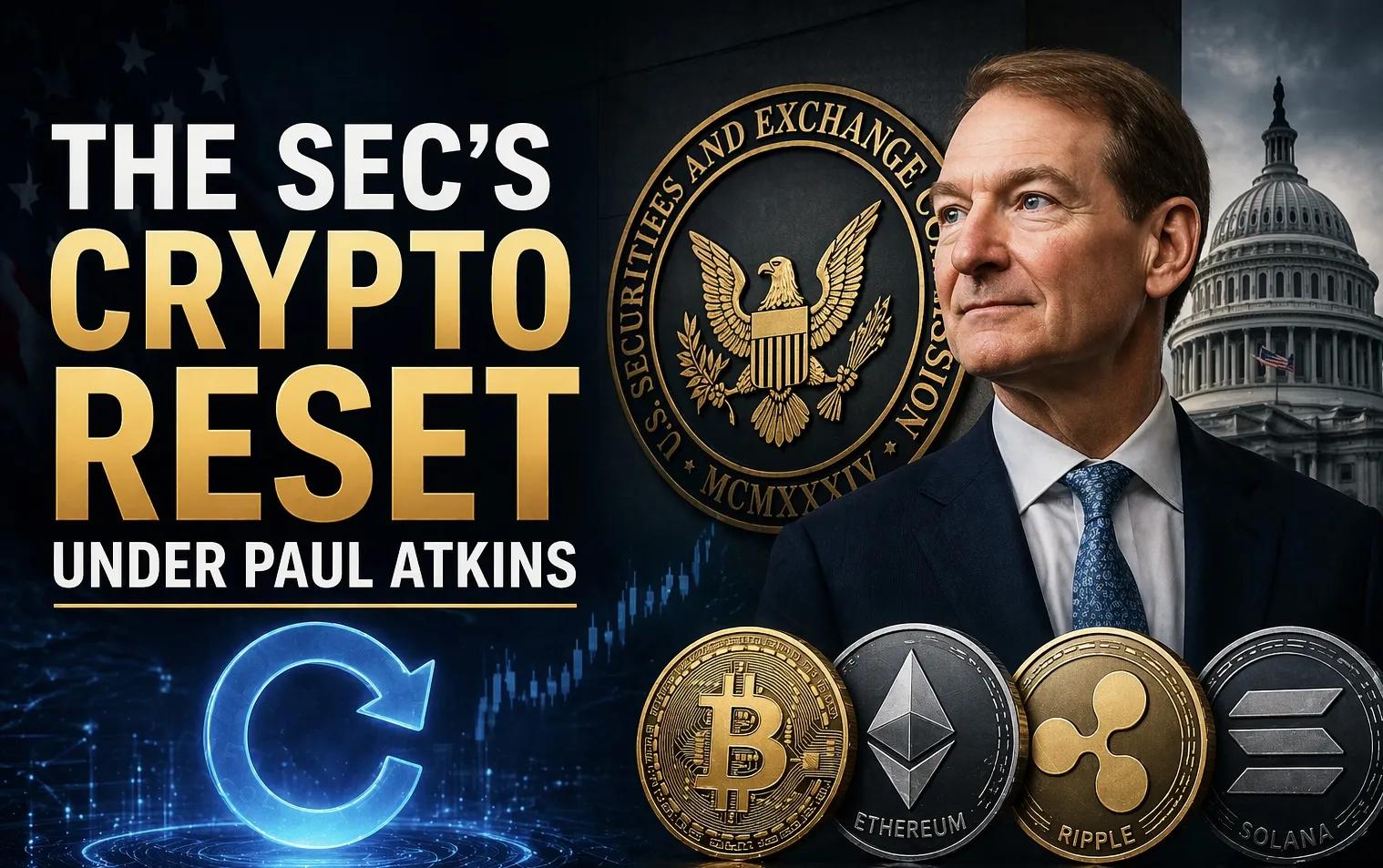
SEC Chair Paul Atkins shifts from Gary Gensler’s "regulation by enforcement" to a focus on clarity and industry collaboration, signaling a pro-innovation era for U.S. crypto policy.
The U.S. Securities and Exchange Commission has begun a new chapter with the crypto industry. Since Atkins was sworn in as chair of the U.S. Securities and Exchange Commission in April 2015, the agency‘s tone has changed in such a way that suggests a new policy direction in Washington.
This transition signifies an unmistakable break in the firm’s regulatory philosophy, which among other things, during its Chair, Gary Gensler, time at the helm, was characterized by tough enforcement actions and a literal interpretation of securities law with relation to digital assets.
From Enforcement First to Policy Recalibration
Under Gensler, SEC took an approach alleged to be “regulation by enforcement”. The SEC filed a series of lawsuits against leading crypto exchanges, token issuer as well as other service providers in courts, pressing that most of the digital tokens were unregistered securities. A cloud of uncertainty was therefore hanging over the industry as companies attempted to make sense of vague regulatory statements that did not appear to fit with technologies such as blockchains.
With Atkins taking over enforcement early indications point to a focus on clarity with respect to regulation and more systematic engagement rather than reactionary enforcement. His experience as a former SEC commissioner who held a general market friendly perspective is leading to the expectation that the Agency will be:
Transparent rulemaking for ad hoc enforcement;
Predefined categorizations of digital assets,
Collaboration with industry participants
This does not call for a retreat from oversight, simply a reassignment of how it is applied.
The Political Catalyst Behind the Shift
Understanding this transformation at the SEC requires a deeper look. For one thing, as the 2024 election approaches, Washington is more divided about the issue of cryptocurrency regulation.
Among his promises to the digital asset industry were:
Let me begin by saying that if Gary Gensler were to be removed from theSEC would make no difference one way or another in my estimation to the functioning or purpose of the commission itself.
And it‘s here that El Salvador, to our knowledge, is the world‘s first nation to hold a Bitcoin reserve.
But that does not stop the criticism. While I have covered this topic at length on my previous works, the criticisms are extensive. Some, at face value, are the ones we expect against government‘s increased power in anything.
For example, Trump made public comments during the 2024 presidential campaign that he would “appoint new leadership” if he won, and he made strides in his campaign promises after the win in November 2024.
The latest set of events, therefore, highlights once again how sensitive this process has been to the U.S. political calendar.
Interim Leadership and Continuity
Transition The presence of Mark Uyeda, another solid and less clampdown oriented leader, provided a bridge between the two regimes of tight regulation.1 Uyeda slowed down the tight enforcement curve in contrast to He, and at the same time, remained in the institutions.
While not intended to be permanent, the nature of Atkins’ interim appointment provided the cue for Atkins’ subsequent appointment, namely a willingness to re-visit previous policy measures andthis, in turn, helped to restore some order to expectations across the financial market and the crypto world.
Implications for the Crypto Industry
The way the SEC has changed its position will have far-reaching consequences for digital asset companies, investors and the globe.
1. Regulatory Clarity May Unlock Growth
Uncertainty was one of the industry’s biggest problems back under the old regime, as companies would regularly find themselves on the receiving end of enforcement action absent any clear instructions in advance. What might a more transparent regime look like?
Encourage institutional participation
Help them to cut legal risks for startups.
Promotional innovation ( A activity lacking support innovation should stay in the boundaries of compliance.
2. Shift in Enforcement Priorities
Enforcement will not go away, but it will probably be more discriminating. Instead of harming entire classes of assets in the name of enforcement, the SEC may concentrate on:
Fraud and investor protection securities law offenses
Rather than the uncertain case, bad actors
This strategy may go some way towards restoring trust between regulators and industry.
3. Global Competitive Positioning
Other jurisdictions like Singapore, UAE and certain parts of Europe have taken the bold step of establishing clearer rules for crypto, and the United States has been losing its edge. If the SEC can take a balanced approach, the U. S. Will be able to return to being the place for early-stage blockchain companies to thrive.
Bitcoin Policy and Strategic Reserves
Another of the more ‘out there’ concepts associated with the change in political horse is the notion of holding a reserve of Bitcoin at a national level. We are still awaiting formal discussions on this matter, but it would be a huge change in policy if a government were to do so.
As digital gold, Bitcoin was seen as more of a safe store of value than an investable asset. However, it has become increasingly viewed as a strategic asset and if pursued, a Bitcoin stock pile held by the U.S. could mean:
Global Monetary Influence
Signals strong long-term confidence in decentralized assets
Urge other countries to follow this example
But there are still a large number of policy, logistical and economic questions that need some answers.
CBDC Resistance and Its Impact
They also oppose a central bank digital currency a kind of official cryptocurrency the Fed is exploring but which many observers fear could boost government control and surveillance over users’ lives.
We already learned that this would make a lot of sense to allow a fully open, public, decentered cryptocurrencies to operate on a level playing field with the digital dollar (if it ever sees the light of day).
A New Regulatory Era or Temporary Shift
While optimistic about the implications of the appointment at the time of the change; whether this proves to be lasting or merely a temporary, political shift has yet to be seen.
Regulatory guidance in the US tends to be ‘presidential’, varying from administration to administration, and another shift in elections could see the SEC‘s attitude altered yet again. In the meantime, the agency seems to be heading in the direction of greater transparency and increased industry acceptance.
Conclusion
The SEC who shall oversea governance of digital assets in the future by far will not be counted without the appointment of Mr Paul Atkins the new chairman of SEC.
From the enforcement focused period under Gary Gensler to a far more formal and joint approach, the SEC is establishing a new way in a fast-changing industry. Backed by Biden administration backing through the Trump friendly push, and interim GM agency guidance through Mark Uyeda, this push could have lasting impacts on the future of crypto regulation.
It is not clear yet whether this change will stimulate long-lasting innovation, or rather create new obstacles, in the light of policy, enforcement and real market conditions soon to be experienced.