Texas Man Sentenced to 23 Years in Major Cryptocurrency Fraud Case
 Linda Titianitus2026-04-23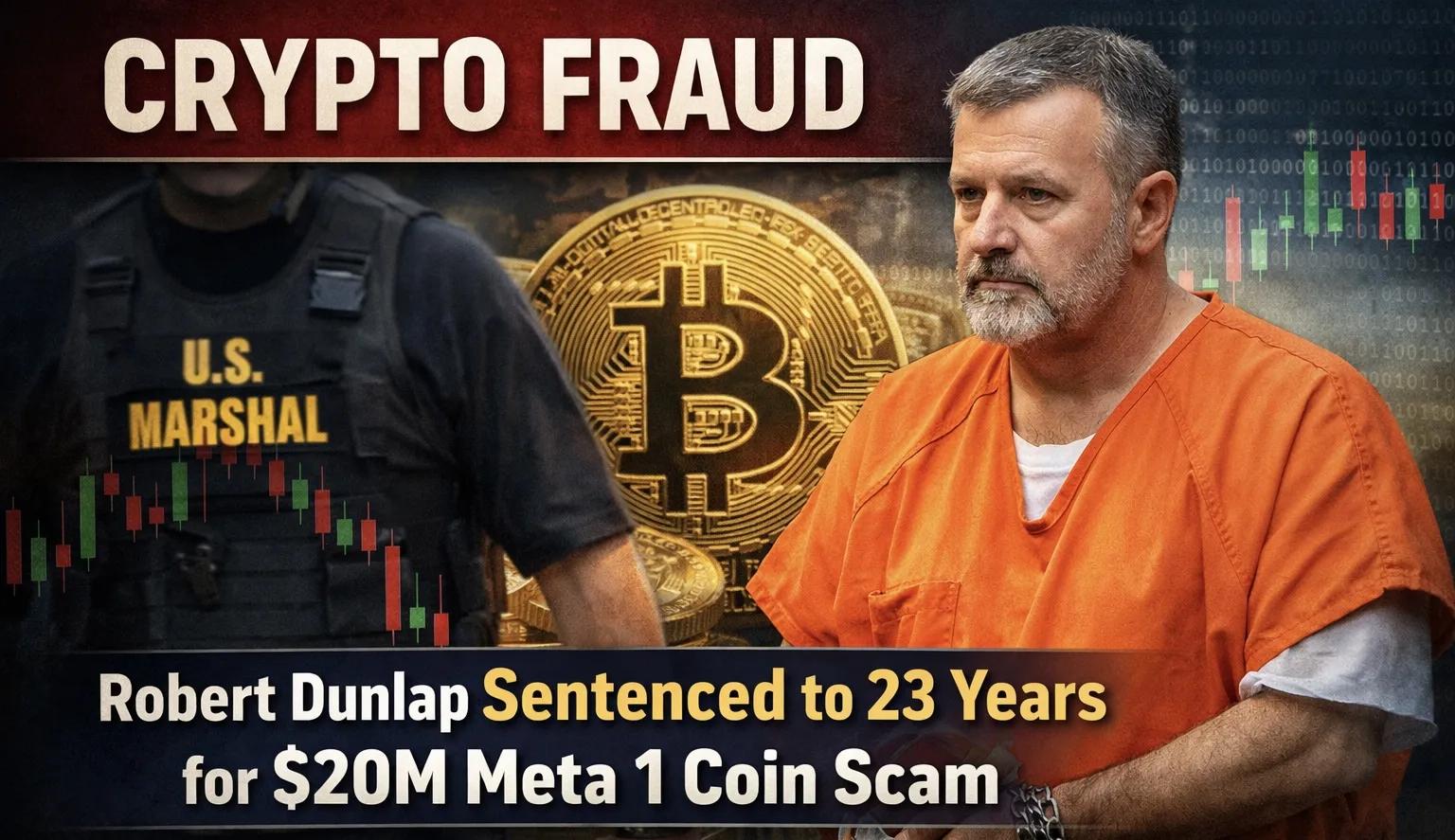
Texas man Robert Dunlap gets 23 years for $20M Meta 1 Coin crypto scam that defrauded 1,000 investors, signaling tougher US crackdown on digital asset fraud.
A man from Texas received a 23-year sentence imposed by a US federal judge, for his involvement in orchestrating a large-scale fraud scheme that defrauded approximately 1,000 investors of around 20 million dollars, using cryptocurrencies. This instance once again emerges as a strong indicator of the growing crackdown in digital assets by the law enforcing agencies of the country.
U.S. District Judge LaShonda Hunt passed on Tuesday a sentence against Robert Dunlap, a trustee in a fraudulent investment project. He was sentenced to prison and restitution to the victims financially harmed by the scheme.
The scam was based on a fictitious digital currency investment scheme called Meta 1 Coin. Federal prosecutors said thescheme was fictitious, completely false and a trick to get investors to believe they were involved with an authentic high-value digital asset opportunity.
Background of the fraudulent investment scheme.
Based on court rulings and the testimony of federal prosecutors, Meta 1 Coinwas built on unsubstantiated allegations, deceptive marketing, and fabricated promises to gain the trust of its investors.
The project was marketed as an ‘evolution’ in cryptocurrency built on tangible real world assets. Investors were led to believe that the free coin had real backing from high value tangible assets such as gold, fine art and other expensive assets.
But subsequent investigators exposed all those claims to be false. There was not one confirmed asset reserve nor any genuine economic or financial base backing the coin. It was simply a front for a scam raising funds through slick advertising.:
Victims were persuaded to invest on the promises of high returns and early access to what was said to be revolutionary new financial system. Victims claimed that the majority of the people who invested had been recruited after seeing internet presentations, promotional events and by referral marketing strategies that created a sense of legitimacy.
The scheme how the scheme almost 1,000 investors what was attracted to the scheme.
The Meta 1 Coin scam was supposed to be available to retail investors who are new or experienced in the financial and investment marketplace. It was promoted using high quality marketing material coupled with being promised that the venture was supported by institutional grade resources.
Participants were encouraged that the investment opportunity was time sensitive and scarce. They were motivated to rush to make the investment before others without conducting sufficient due diligence. This is a typical approach employed in investment scams, especially those relating to novel finan cial technology that is not yet widely understood.
More investors were brought in by word of mouth and social networks, as the project grew bigger. Many investors thought they were investors in a real early blockchain project with huge potential for growth. In total about 1000 investors were lost, with estimated losses worth about 20 million dollars.
Role of Robert Dunlap in the Operation
Robert Dunlap. Dunlap was placed as a trustee of the organization and prosecutors argued this meant he was credible and had power over what investors thought of the scheme. Dunlap‘s position was designed to back up the project and lend weight to the argument that the scheme was valid.
Federal prosecutors said Dunlap was involved with pushing the scam and put up with the growing pressure of the project, when the Trustees are generally seen as the ‘pillars of responsibility and probity’.
Solely in the absence of transparency, prosecutors maintained that Dunlap helped promote false information. Court records revealed that he remained engaged with the project despite growing worries about its validity.
In court filings, Assistant United States attorneys Jared Hasten and Paige Nutini said his actions “over the years” became more and more false and that he no longer attempted to dispel rumors and “instead egged investors on and let their sentiment continue.”
Court Proceedings, Sentencing Decision
At sentencing Judge LaShonda Hunt gave Dunlap a 23 year prison sentence which was commensurate to the degree of the offending and the wide spread damages caused to the victims. Among other orders the court made a restitution order to enable investors to recover losses in the case.
The sentence demonstrates that United States courts are regarding more severely larger scale cases involving cryptocurrency fraud with many victims and an important loss.
In passing sentence the court took into account among other things the scale of the fraud, the number of victims involved and the period of time over which the scheme lasted. Prosecutors contended that the deception was neither sporadic nor accidental but was a prolonged attempt to deceive investors.
Prosecution‘s Arguments and Characterization of Conduct
The federal prosecutors were vehemently against any leniency. They wrote in their sentencing memorandum that Dunlap was frankly unrepentant (and) failed to admit the extent of damage inflicted on victims.
They also found that in laying out his defense, he had lied repeatedly and continued doing so over time. “As he said more and more, he continued to mislead investors more and more,” said one of the prosecutors.
The prosecution highlighted the necessity of deterrence in situations such as this. They stated that the consideration must have had strong sentences in order to serve as a warning to any other entering into cyber or digital asset related deception.
Advised that people about to do such things should be aware that it will result in harsh punishment; a long time off one‘s liberty.
Effects on Victims and Financial Impact
According to investigators, the victims of Meta1 coin scheme included almost 1,000 investors with estimated loss of 20,000,000 USD. Almost all investors were the personal investors who were enticed by the ability to participate in the burgeoning digital asset early.
For many victims the financial loses were substantial and life changing in some instances. The emotional toll that this type of financial fraud can take is also large as investors often feel betrayed after has believed they were investing in real financial innovation.
This demonstrated the risk that individual investors face and the risks that can occur when financial markets are changing rapidly and regulation is not always keeping up with that change. As in the above example, frauds and fraudsters can make use of the knowledge gaps as well as the ambigious instructions.
More General Implications for Regulation of Cryptocurrencies
The sentencing takes place during increased activity in the oversight and policing of the space by regulators and law enforcement agencies. As mainstream uptake of digital assets builds, more incidences of fraud, counterfeit tokens and false investment schemes have also emerged.
In the US, the authorities have time and again issued warnings for investors to remain vigilant in investments that offer guaranteed returns, or that are supposedly backed up by real assets.
Regulatory bodies have been also providing efforts to strengthen enforcement by enhancing cooperation among authorities in different areas in order to enhance the strategies to detect and eliminate existing fraudulent schemes early in their years of operation.
The Meta 1 Coin scam shows us that although the technology using blockchain is not a scam in itself, there are people who would take advantage and use it to deceive people into thinking the financial platforms are safe.
Lessons from the Case
This case reminds us that
The first consideration is that any investment opportunity that appears to offer high returns with minimal risk deserves special attention. The fact is all investment products involve risk, and any proposition of ‘guaranteed’ profit usually indicates a scam.
The second point concerns disclosure. Truly authentic projects will reveal documents explaining the project structure, who the developers are, and what the actual technology behind the project consists of. obscure documentation raises suspicion!
Third, investors should investigate independently of promotional material and tweeting power. Preventing and detecting frauds rely more on marketing than material.
Conclusion
The 23 year prison sentence imposed on Robert Dunlap represents a milestone in the continuing battle against cryptocurrency fraud. The case provides insight into the severity of possible repercussions for those involved in criminal activities of this nature and indicates the growing resolve of US authorities to find justice through the realm of cryptocurrencies.
While cryptocurrency investment is still relatively immature and at the forefront of much media attention in today‘s environment, investor education, regulation and enforcement actions are not any less crucial. The lesson to be learnt from is that any scam, however face value, will eventually be subject to law and heavier sanctions.